AI-Era Security: I Would Start with the Services Around My Website
Reviewed October 23, 2026. This is editorial analysis of public sources, not an assessment of a breach at MSL or another organisation.
Every useful AI connection can add another place where a creative team stores work or grants access. Before connecting the next service, I would want a clear picture of the services already surrounding the website.
The announcement, and its limits
Gartner published urgent recommendations for Japanese enterprises on October 13; Ledge.ai covered them on October 20. Gartner warns that AI and agents can expand the speed and scale of attacks. It does not establish that AI was used in every recent Japanese incident. Its response spans exposed systems, access settings, logs, suppliers and recovery, rather than prescribing a single new product. Read the official announcement.
Why I would look beyond the website itself
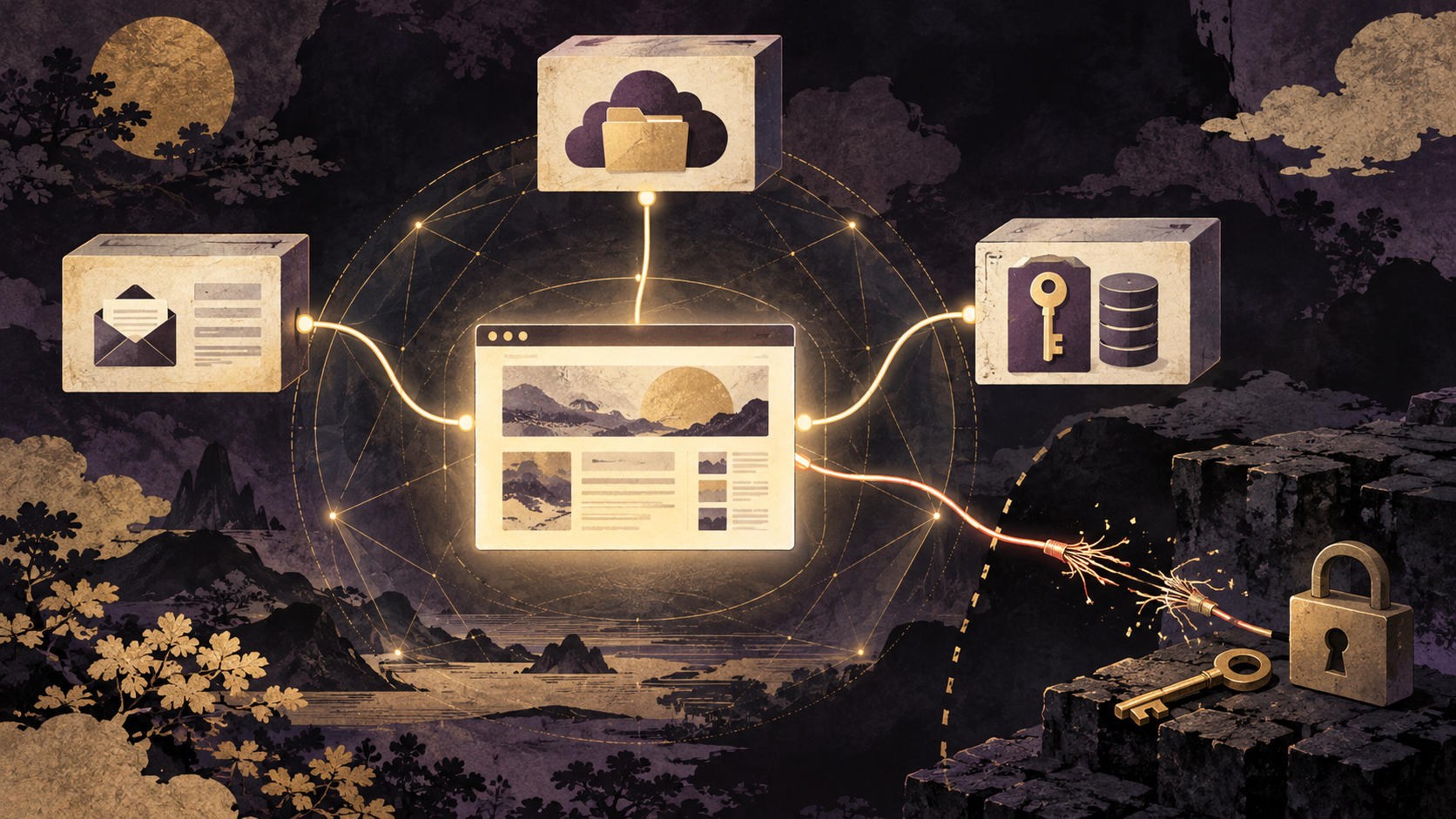
A publishing workflow includes more than the pages a reader sees. An enquiry may pass through a form provider and an email inbox. A delivery may live in shared storage. A posting service may have its own access to an account. Different people can own each relationship, leaving the publisher without a complete view.
That is an editorial concern, not a claim about the cause of the reported incidents. Consider a completed project whose collaborator access remains in place. Before spending time comparing another model, I would ask whether someone can still explain the purpose and owner of each existing connection.
Three conversations I would prioritise
The person receiving enquiries and the person storing them
A notification arriving successfully does not tell me where the underlying information is retained. I would ask the responsible people to explain the storage location, the necessary retention period and the contact for problems. Uploading an unclear collection of personal information to an AI tool would not resolve that uncertainty.
The original production team and the person taking over
Who now maintains the service? Is an old administrator the only person who understands a critical account? Who may approve a configuration change? I would use a handover conversation to expose mismatched responsibilities. This is not a suggestion for an editor to alter a live system’s permissions without the responsible administrator.
The external provider and the person deciding whether to pause publication
If the provider reports a problem, its message needs to reach someone who can make an operational decision. I would also discuss whether an alternative publishing or delivery route is necessary. The answer depends on deadlines and information sensitivity, not simply the feature list of the service.
Keep technical checks with the responsible team
JPCERT/CC’s notice was published October 8 and updated October 9. It also addresses systems intended for administration and operations. Its official notice covers API access controls, permissions and token handling. Administrators should apply that guidance in context: reported indicators and attack patterns are not universal explanations for every incident.
What I would adopt, and what I would defer
I would adopt a discussion of existing connections and ownership before adding another integration. I would defer buying a product merely because it is marketed as an AI security response. I would also decline to send confidential logs directly to a general-purpose AI service as a shortcut.
For me, an integration needs a reason, an accountable owner and an understood consequence if it stops working. Those decisions give a small publishing team a basis for talking to specialists. They do not establish that a system is secure.
If compromise is suspected, ordinary publishing work should give way to the organisation’s incident process and the responsible team. This article is not a diagnostic procedure, a compliance determination or a substitute for that response. My editorial position is narrower: faster AI should make the human decision points clearer, not less visible.
Sources and review date
- Gartner’s urgent recommendations, October 13, 2026.
- JPCERT/CC’s advisory, published October 8 and updated October 9.
- Discovery: Ledge.ai coverage, October 20.
All sources checked October 23, 2026. Access conditions: this article uses public information and does not require subscribing to a security product. Any operational changes depend on the organisation’s permissions and policies. The proposals above have not been presented as measured MSL outcomes.