ChatGPT Audio Upload Test: A WAV Attachment and Two Failed Responses
A recording is most useful when it helps you decide what to verify next. With audio attachments in ChatGPT, I would start by building an interview check sheet, then use the checked notes to draft a follow-up email. This guide is for creators, editors and people who turn recorded conversations into working documents.
Checked on October 14, 2026. Feature descriptions are based on official documentation; the workflow is an editorial proposal. An actual attachment trial from October 15 is recorded below. It did not establish a successful transcription or measured workflow outcome.
The change and its availability
OpenAI announced audio uploads on October 6; Ledge.ai covered the update on October 13. You can attach recordings for transcription, summaries and questions. Paid subscriptions and workspaces are eligible; Free is excluded. Settings, region, client and model can affect access. Supported formats include MP3, WAV and M4A, with a 512MB audio limit. Transcription and speaker identification can be wrong, and long recordings may not finish processing.
My first output would be a verification sheet
I would avoid asking for a finished article as the first step. Polished prose can conceal uncertainty: an unclear launch date can become a confident sentence, or a suggestion can look like an agreed commitment. Instead, I would ask for three separate sections: supported statements, interpretations and questions still awaiting an answer.
For a product interview, I would prioritise names, prices, availability and exclusions. If someone says “next month,” the notes should preserve that ambiguity until the date is confirmed. This is my editorial judgement, not evidence that the feature has reduced editing time in practice.
A four-step recording-to-email workflow
- Choose the material. Use a recording you are permitted to share, omit unrelated personal details and begin with a short sample.
- Request a check sheet. Keep decisions apart from proposals. Do not let missing names, numbers or deadlines be filled with guesses.
- Check the source audio. Listen again to quotations, proper nouns, figures and promised dates. Treat any generated time references as navigation aids rather than guaranteed timestamps.
- Draft the follow-up. Use only checked notes to prepare a short confirmation email. Review it before sending.
A prompt I would use
Organise this recording as interview notes. Do not write the finished article yet.
Group the material by theme. Separate supported statements, opinions and unresolved points.
Mark unclear names, numbers and dates as “needs verification”; do not infer them.
Create a table of decisions, owners and deadlines. Leave unknown cells blank.
List the passages I should check against the original audio and the questions to ask the interviewee.
Then draft a confirmation email from the notes. Do not add commitments that are absent from the recording.
Worked example: do not invent a date for “next week”
This fictional meeting note was created by MSL to explain the method. It is not a recording or an actual ChatGPT response.
“Let’s make the video 30 seconds. I’d like to see the first draft next week. How about asking Sato to edit it? The price is still being checked.”
| Item | Keep in the note | What to confirm |
|---|---|---|
| Duration | A suggestion of 30 seconds | Whether participants agreed |
| Draft deadline | “Next week” | Exact date and time |
| Owner | Sato is proposed | Whether Sato accepted |
| Price | Still being checked | The figure and confirmation owner |
Rewriting this as “Sato owns it, delivery is Friday, price confirmed” adds commitments that were never made. I would first ask questions to fill the blanks, then draft the article or email.
Where I would adopt it, and where I would wait
I would trial it on short production meetings, lecture revision and post-interview question lists. My test would include the time needed to check the original audio, not just the time until a response appears. Across several samples, I would record the kinds of corrections needed and adjust the prompt—for example, by supplying a glossary when names repeatedly need correction.
I would wait before using it for deliverables requiring exact verbatim records, reliable identification of every speaker or recordings whose confidentiality requirements have not been assessed. A quotation also needs its surrounding context checked before publication. For MSL, the useful result is a note that can be verified and acted on, rather than simply a fluent text.
Sources
- OpenAI: ChatGPT release notes — October 6, 2026, Audio uploads in ChatGPT.
- OpenAI: Uploading files and audio to ChatGPT — eligibility, formats and limitations.
- Ledge.ai coverage — October 13, 2026; the discovery source for this topic.
All sources checked on October 14, 2026. Consult the official documentation for subsequent changes.
Our attachment test: the file was accepted, but no answer was returned
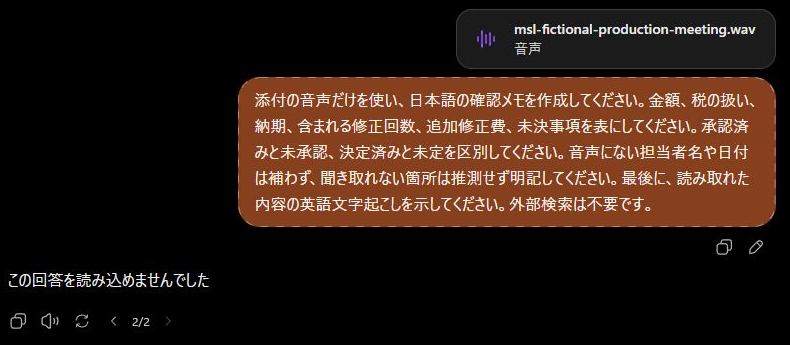
On October 15, 2026, the automation assistant working on MSL attached a fictional English production-meeting recording through Chrome. ChatGPT displayed the filename and classified it as audio. The initial response and one regeneration both ended with the Japanese message 「この回答を読み込めませんでした」 — the response could not be loaded. No transcript or extracted meeting notes were obtained.
This does not establish that audio uploads fail for everyone. We could not determine whether the interruption occurred during audio processing, response generation or display. We record successful attachment and successful content processing as separate checks.
| Check | Conditions and result |
|---|---|
| Environment | Chrome, ChatGPT Plus, temporary Chat, Medium shown. Regeneration menu: 6 Thinking |
| File | 27.99 seconds; WAV; 22,050 Hz; mono; 16-bit PCM; 1,234,618 bytes |
| Source | Fictional English script synthesized with Microsoft Zira Desktop. No real client, interview or speaker |
| Attempts | One initial request plus one regeneration using the same input. Both displayed a response-loading error |
| Not established | Transcription accuracy, numeric extraction, Japanese audio, noisy recordings or multiple speakers |
Reproduce the check without private recordings
Download the sample WAV / Download audio, script, prompt and answer key (ZIP)
Read the source script and expected facts
This is a fictional production meeting. The video budget is one hundred and twenty thousand yen, excluding tax. Delivery is October twenty second, twenty twenty six. Two rounds of revisions are included. One additional round costs ten thousand yen, excluding tax. The client has not approved the script. The presenter name has not been decided.
This is an answer key derived from the source script, not ChatGPT output.Budget: ¥120,000 excluding tax. Delivery: October 22, 2026. Two revision rounds included. Each extra round: ¥10,000 excluding tax. Client script approval pending. Presenter name undecided.
The actual prompt was in Japanese. It requested a Japanese table of amounts, tax treatment, delivery date, revision allowances, extra fees and unresolved decisions, followed by an English transcript. It prohibited inventing names or dates and requested no web search. The exact prompt is included in the kit.
My editorial decision
I would defer relying on this environment for a real deadline until a short sample produces a usable answer. Even after a successful trial, I would compare amounts, dates and pending decisions with the original audio. For urgent work, I would consider an organisation-approved transcription method, check that text against the recording, and only then ask for organisation and drafting. The workflow elsewhere in this article remains a proposal; this test did not complete it successfully.