AI Fact-Checking Workflow for Creators: A 7-Step Checklist
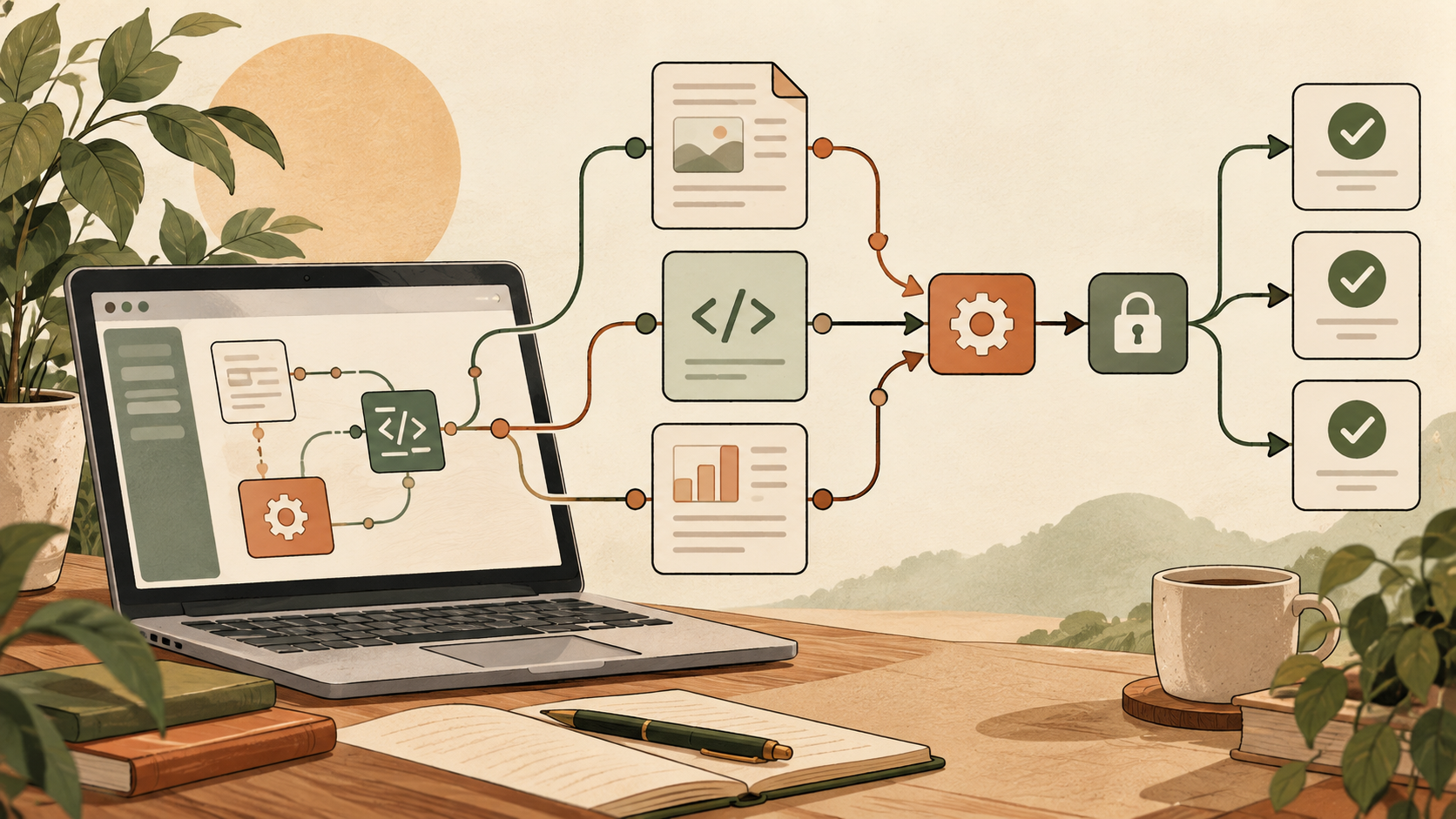
Quick answer: Treat AI output as a draft, not evidence. Before publishing, isolate every checkable claim, trace it to a primary source, confirm dates and units, verify quotations in context, test links, and record what you checked. This seven-step workflow is fast enough for routine creator work and strict enough to catch the mistakes that damage trust.
Last verified: September 5, 2026.
Why confident AI answers still need verification
Generative AI predicts useful language. It can summarize well and still merge two events, use an obsolete product limit, invent a citation, or state an estimate as a fact. The risk rises with fast-moving AI products, social-platform rules, prices, laws and statistics. A polished sentence is not proof.
The practical goal is not to distrust every sentence. It is to separate claims by risk and spend checking time where an error would matter. Definitions and general workflow advice usually need a lighter check. Exact limits, dates, quotations, safety claims and legal or financial statements need direct evidence.
The seven-step verification workflow
- Mark checkable claims. Highlight every number, date, named feature, quote, policy statement and comparison.
- Assign a risk level. High-risk claims affect money, rights, safety or reputation. Medium-risk claims include specifications and product availability. Low-risk claims are clearly labeled opinion or advice.
- Find the primary source. Prefer official documentation, release notes, standards bodies, filings or the original research paper.
- Check scope and date. Confirm country, plan, device, account type and publication date. A feature can be real but unavailable to the reader.
- Triangulate important claims. For consequential claims, compare the primary source with a second independent, reputable source.
- Test the output. Reproduce the setting, calculation or workflow when possible. Save screenshots or notes for facts you may need to update.
- Publish uncertainty honestly. Use “as of,” “the company says,” or “in our test” when the evidence has limits.
A compact claim log
| Claim | Risk | Best evidence | Decision |
|---|---|---|---|
| Upload limit | Medium | Official help page | State exact plan and date |
| Tool is “best” | Medium | Repeatable comparison | Define the test first |
| Quoted statement | High | Original transcript | Check context and wording |
| Legal requirement | High | Regulator or statute | Add jurisdiction; seek expert review |
Prompts that make checking easier
Ask the model to return a claim table, not another smooth rewrite: “List every externally verifiable claim, its likely source type, the date sensitivity, and what would falsify it.” Then do the verification outside the model response. Never accept a citation merely because the URL looks plausible.
For research-heavy projects, compare this method with our guide to deep, cited AI research and the broader generative AI primer.
FAQ
Do I need two sources for every fact?
No. One current primary source is often enough for a simple product specification. Use independent corroboration when the claim is consequential, disputed or easy to misinterpret.
Can an AI tool verify its own answer?
It can identify claims and suggest sources, but that is not independent verification. Open the source and inspect the relevant passage yourself.
How often should an article be rechecked?
Recheck fast-changing specifications on a schedule and whenever the platform announces an update. Displaying a last-verified date makes that maintenance visible.
Example: verifying a fast-moving product claim
Suppose a draft says an AI tool now supports a specific file type on every paid plan. First, split the sentence into three claims: the feature exists, the file type is supported, and every paid plan includes it. Open the official product document, note its date, and confirm whether the language applies to beta access, a region or an account tier. Then test the feature in an eligible account or clearly label the statement as documentation-based. This decomposition prevents one partially true sentence from passing as a fully verified claim.
Editorial handoff checklist
- Claim log attached to the draft
- Primary URLs opened and dated
- Quotes compared with the original
- Calculations repeated independently
- Uncertainty visible to the reader
- Next review date assigned
References
- OpenAI: Evaluations guide
- Anthropic: Define success and build evaluations
- Google Search Central: Creating helpful, reliable content
From the publisher: how I would decide
I would reserve the word “checked” for claims whose sources I actually opened and compared. In MSL articles, exact prices, limits and release dates deserve particular attention because they can change the reader’s decision. I would keep unresolved details out of a confident summary and record the date beside time-sensitive evidence. AI can help build the claim list, but I would not let another fluent AI answer become the proof. A shorter article with traceable facts is the version I would prefer to publish.